Link Loving 05.02.11
February 5, 2011 § Leave a comment
- Michael Levi at the Council on Foreign Relations takes down the oil industry – one subsidy at a time.
- If you want a healthy dose of good R’n’B through the years, head on over to Ben Meaker’s blog.
- McKinsey examines how green China’s cities are.
- Paul B. Carroll and Chunka Mui name the four principles for crafting your innovation strategy.
- Mark Bittman has a food manifesto for the future and it includes taxes. So shuddup and sit down.
- Your February trend briefing, sir/madam – especially loving Meine Ernte in Germany and Autolib in Paris.
- There’s been a lot of these recently – games that want to help you save the world.
- While technically impressive, this is an absurdly over-complicated answer to the wrong question says John Thackara.
- As I struggle through my Open University maths course, this gave me some comfort.
- Platform reveal the links between BP and the Egyptian government.
Greenland
February 5, 2011 § Leave a comment
This week I was lucky enough to go and see a preview of the National Theatre’s latest climate change-themed production, Greenland. I only just made it on time, so wasn’t able to examine the audience as closely as I’d liked – though around me were sitting the usual Southbank crowd of Power Gays and culture vultures. But I wasn’t the only one laughing at the climate ‘in jokes’ (yes – they exist), so I can’t have been the only climateer.
The play is made up of roughly fifteen characters – a teenager being radicalised by her reading and experiences, a junior DECC minister and her relationship with a climate scientist, an Arctic-visiting bird lover, a young geography student etc etc. The story moves around quickly, though I’d see it more as an issue-exploration play, rather than a gripping narrative.
Visually, the production is stunning. The production uses the space inventively, and there were moments when the dialogue and the visual elements come together beautifully and pack an emotional punch.
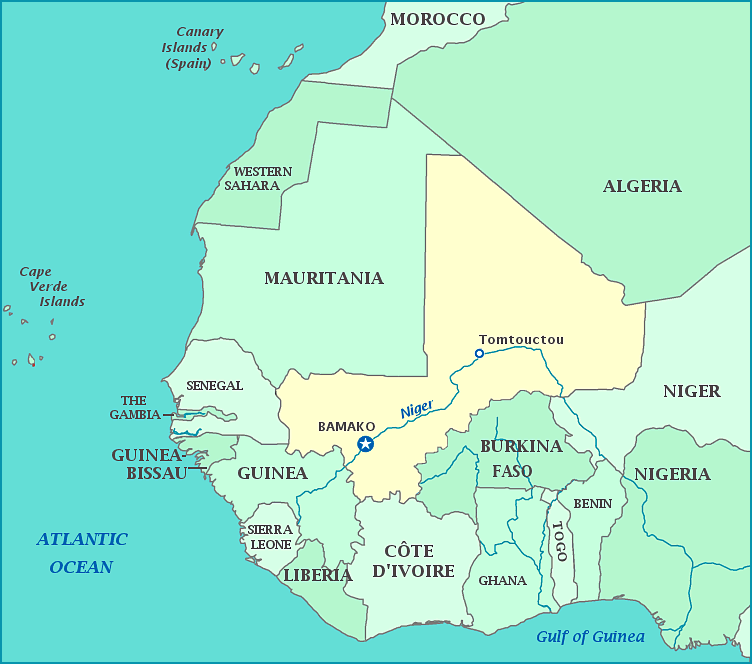
At times, the piece veers into ‘public education’ – you know the drill; a scientist explaining the dangers of climate change, a UN official explaining the role of the UN Secretariat, the lead Malian negotiator informing you of the capital city of his country. I was very tempted to shout ‘Bamako‘ really loudly, but thought this might ruin the dramatic effect…
Most striking though, is the fact that what is being represented on stage is very close to my own experience. As a climate activist, I felt as if my story – and the stories of so many of my friends – was being told by these actors on the stage. The idealistic young activists, the bureaucracy and politics of Copenhagen, characters feeling the ‘fear’ for the first time – each of these are things I know well.
Anna Collins often talks about the need for us to change culture in order to be able to change politics, or at least for one to reflect the other, and I’m inclined to agree. This production is one step towards achieving that, and the National ought to be commended for taking the risk and going for it! They’ve also got a good series of ‘in conversation with‘ events around this production (*Bjørn Lomberg alert*), so do have a look – it’ll surprise you how much you enjoy it.
Many thanks to Becky at the National Theatre and Kirsty Schneeberger for the ticket.
And if you want to see how you bring narrative and emotions into climate stories – this is how you do that.
Inner City Permaculture – Where An Apple Tastes Like An Apple
February 5, 2011 § Leave a comment
Stories like this that come from poor neighboorhoods, ‘food deserts‘, always inspire me. Rediscovering old knowledge, inter-racial and inter-generational relationships being built, sustainable agriculture, job-creation – a paradigm shift in action.
The San Francisco Chronicle also carries the story of the transformation of this community.
Link Loving 04.02.11
February 4, 2011 § Leave a comment
- So…that off-shore oil drilling moratorium? It’s gone. And who is in charge? That’s right – Big Oil, explains Natalya Sverjensky.
- After the excitement from the Middle East, is China next? No, says Christina Larson.
- The Onion is so wrong (but so right).
- Craig Scott argues it’s high time to re-examine US foreign policy and who it cozies up with.
- Improv Everywhere are up to their old tricks – this time on a skating rink.
- The Australian floods – before and after.
- Kit Eaton at Fast Company asks us to dream bigger on clean energy.
- Why does Ze Frank love the internet? Because of user-controlled zombie choirs.
- The reality of cycling in London. Glad someone has done this. A system’s theorist would say – this is what happens when you add more information to the flow…
- Adam Ramsay tries to figure out when a President stops being a President? Maybe if your name is Mubarak?
The First To Know
February 4, 2011 § 1 Comment
This book may be for corporate marketers and hipster insiders, but there’s something in this for social change-makers too. I’m just not quite sure what it is yet.
A Thinking Celebrity – Russell Brand On Consumerism
February 4, 2011 § Leave a comment
Well this is a surprise.
The death of grand ideas, the feeding of the grey sludge of celebrity, on being a commodity, attacks on Paul Dacre – this is one hell of an interview of Russell Brand with Jeremy Paxman on Newsnight late last year.
Ever seen Paxo so overwhelmed?
Link Loving 03.02.11
February 3, 2011 § Leave a comment
- Jules Evans finds the meaning of life. According to the Con/Dem government.
- Clive Thompson reports on the amateur mathematicians trying to break the ‘Napoleon Dynamite’ code.
- Surprisingly beautiful short story recorded for you to listen to when in the bath. h/t Hanna Thomas.
- HuffPo on the depressing capitulation by organics corporations to Monsanto.
- An amazing account of how Egypt’s traditional pro-democracy leaders are falling into line behind a new generation of young people.
- David Roberts at Grist.org tries to explain why clean energy (hooray!) is not the same as climate change.
- A warning for digital campaigners – a new report shows that Congress staffers are not interested in blast emails.
- Canadian left-of-center may dominate social media, but the terrifying Mr Harper rules supreme on Google.
- Adam Ramsay on how the Treasury is blocking the proposed joys of a green investment bank. And not letting it be a bank. Which sort of defeats the point.
UK Uncut On BBC Newsnight
February 3, 2011 § Leave a comment
I watched this segment on Newsnight when it aired and was really impressed. It feels partly like a public education campaign on what direct actions is – much like Just Do It will be doing when it premieres later this year. UK Uncut have done wonders for energising the anti-cuts protests, and bringing in a lot of valuable experience from the environmental movement, particularly the fabulous Climate Camp.
Good to see some friendly faces in the clip too : )
Pierre Rabhi And A Campaign Without A Candidate
February 3, 2011 § 1 Comment
Something interesting is happening in France, according to Kristie van Riet. A 73 year-old Algerian-born farmer, philosopher and environmentalist is beginning to impact not just on the electoral process, but one of Europe’s oldest democracies. He’s managing to bring together the French tradition of humanism with the increased national ecological conscience.

Pierre Rabhi was born into a Muslim family an an oasis in southern Algeria, in 1938. His mother died when he was four years old. His father, a blacksmith, musician and poet, was forced by economic circumstances to close his workshop and work in the mines. The father persuaded a French couple to raise Pierre; his childhood thereafter was shared between France and Algeria, and the Catholic and Muslim worlds, until he was 14.
He chose to convert to Christianity when he was sixteen, and completed two years of secondary education, but had to leave college because his family were unable to cover the costs. When the Algerian War broke out in 1954, Rabhi was rejected by his father for having converted to Christianity, and by his adoptive father following a dispute. He decided to settle in Paris.
In France, Rabhi, with no knowledge of agriculture, moved with his new family to the country; this was well before the French ‘neo-rural’ movement of the late 1960s. In 1963, after three years working as an agricultural worker, he became a goat farmer. Appalled by the impacts of industrialised agriculture on ecosystems he had witnessed in the Sahara, and around him in France, he developed the practice of ecological agriculture.
“I am often called a philosopher”, Rabhi told an interviewer, “but you must know that I came to ecology through farming”. On his farm in the Cevennes of Ardèche, he has lived for 13 years without electricity, water, or modern technology. Through this experiment he has discovered that “man has created a radical break between activities that enable them to feed themselves and essential principles of nature. The little plot of land that I cultivated in Ardèche widened my horizons and enabled me to connect with time and space all around the world”
Rabhi wondered whether his experiment was transmissible. In 1985, he set up an agro-ecology training centre; and in 1988 he also founded an International forum for the sharing of knowledge about applied agricultural practices, CIEPAD. “I realized that the South had been trapped by modernity, that it was connected through chemical fertilizers and pesticides” he explained; ‘the South is especially affected by ecological disasters, by the disappearance of animal and vegetal biodiversity, by desertification’. He has since launched oversees development programmes in Morocco, Palestine, Algeria, Tunisiea, Senegal, Togo, Benin, Mauritaniea, Poland and the Ukraine.
Most interestingly perhaps, in the run up to the 2012 French elections, Rabhi has launched a ‘campaign without a candidate’. He is travelling around the country to demonstrate that there is an alternative to politics-as-usual. Describing the campaign as an “insurrection of the conscience”, Rabhi explains that the campaign is not about reforming present society with its ‘banal consumption’ and ‘pervasive fear’. Rather, it is about accelerating the emergence of its replacement.
Awesome.
Link Loving 02.02.11
February 2, 2011 § Leave a comment
- Ramit Sethi teaches us how to negotiate. Useful AND funny.
- Scott Parkin on what the environmental movement can learn from the popular uprising in Egypt.
- Simon Zadek reveals the extent that Africa is now becoming indebted to corporations, rather than nation states, through PFI agreements.
- Paul Krugman challenges the idea that technology has transformed how we live in the last 50 years. Counter-intuitive, but convincing.
- Anna Tims shares her secrets to public speaking.
- Ellie Thornhill spots two new ideas trying to change the advertising industry for good.
- Jules Evans interviews an astronaut and learns about the ‘big picture effect’.
- Sister Rosetta Tharpe sings about her journey to the sky. They don’t make ’em like that anymore.
 Casper ter Kuile